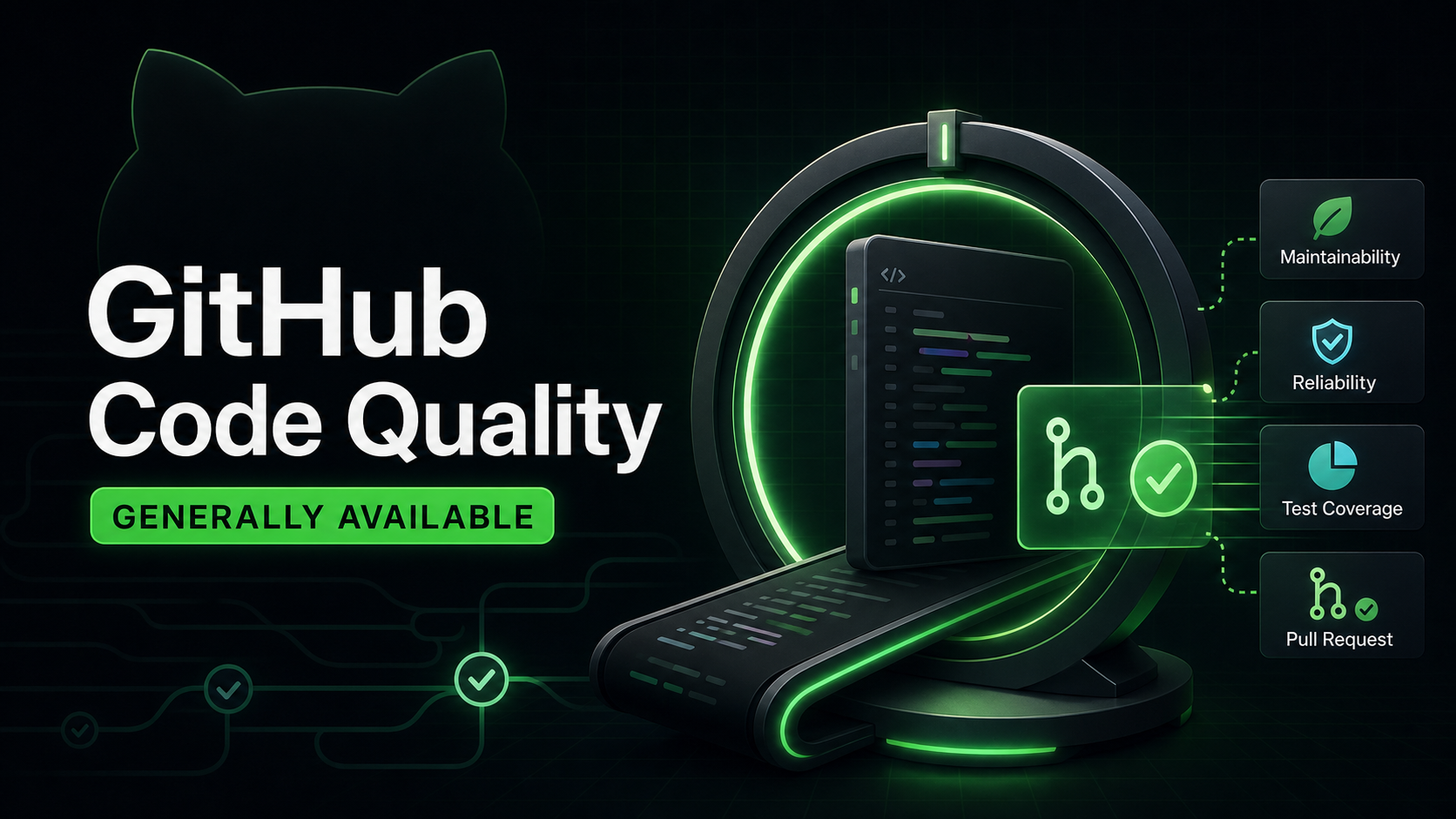
Security scanning tells a development team whether code contains a known weakness. It does not necessarily tell the team that a method has become too difficult to maintain, test coverage is falling or a change is adding reliability problems. GitHub Code Quality, which became generally available on July 20, 2026, is intended to bring those signals into the same pull-request workflow developers already use.
Key takeaways
- GitHub Code Quality is now generally available for eligible organisations.
- It reports findings and repository-level scores for maintainability, reliability and coverage.
- Rulesets can stop a pull request from merging when a configured quality gate fails.
- The announced price is $10 per active committer per month on enabled repositories.
- Automated scoring can improve consistency, but it cannot replace architectural judgement or thoughtful review.
What changed with general availability
The GA release turns Code Quality into a production offering rather than a preview feature. GitHub says customers can deploy it across an organisation, review findings, use quality and security overviews, integrate checks with repository rulesets and prevent merges that fail selected thresholds.
The per-committer licensing model is important for planning. GitHub lists the price as $10 for each active committer per month on repositories where Code Quality is enabled. Before rolling it out everywhere, organisations should identify which repositories need enforced controls and estimate the active contributor count.
How quality gates fit into a pull request
A quality gate is a policy decision applied to measurable signals. A team might decide that a pull request cannot merge if it introduces a critical reliability finding, drops coverage below an agreed threshold or pushes maintainability beyond an acceptable limit.
A typical workflow looks like this:
- A developer opens or updates a pull request.
- GitHub analyses the changed code and associated repository signals.
- Code Quality publishes findings and updates the project score.
- A ruleset compares the results with the organisation’s thresholds.
- The pull request passes, requests remediation or requires an approved exception.
The value is not the score by itself. It is the fact that the team can apply the same rule at the same point in every change, instead of discovering growing technical debt during a late release review.
A practical rollout example
Imagine a company with a customer-facing API, an internal reporting tool and several archived utilities. Enabling the strictest quality gate on every repository on day one would produce noise and resistance. A staged approach is more useful.
The team could begin with the API because downtime has a direct customer impact. For the first two weeks, findings remain advisory while maintainers identify false positives and establish a baseline. The team then blocks only newly introduced high-severity reliability issues. Coverage and maintainability thresholds can follow after developers understand how the tool behaves.
This “new code first” approach avoids demanding that a team repair years of historical debt before shipping its next feature.
Where automated quality analysis helps
Code Quality can be valuable when an organisation has many repositories or distributed teams using different review habits. Central reporting gives engineering leaders a way to see which projects are deteriorating, while inline feedback gives developers a chance to fix issues when the change is still fresh.
It can also reduce repetitive comments. A reviewer does not need to manually flag the same complexity pattern in every pull request if an agreed rule detects it consistently. Human attention can move to domain behaviour, data modelling, security assumptions and whether the feature solves the right problem.
Where teams should be careful
A metric can become counterproductive when people optimise for the number instead of the software. High test coverage does not guarantee meaningful tests. A maintainability warning may be acceptable in performance-sensitive code. Conversely, a clean score does not prove that a system has the correct architecture.
Teams should document an exception process. A developer ought to be able to explain why a finding is acceptable, obtain the right approval and leave a record for later reviewers. Silently disabling a rule is not a durable solution.
What it means for engineering teams in India and the US
For large US enterprises, centralised quality policies can support governance across acquisitions and multiple product groups. The main questions will be cost, integration with existing scanners and avoiding duplicated feedback.
Indian software services companies may find organisation-wide reporting useful when teams work across many client repositories. However, a single global threshold may not fit a new cloud service, a legacy maintenance project and a short-lived prototype. Contractual requirements and client approval should determine where blocking gates are appropriate.
A sensible adoption checklist
- Calculate active-committer licensing costs before enabling repositories.
- Start with important, actively maintained services.
- Run in advisory mode to establish a baseline.
- Block new critical issues before enforcing broad score targets.
- Define owners and a documented exception process.
- Review whether findings duplicate existing CI tools.
- Measure escaped defects and review time, not only scores.
Final thoughts
GitHub Code Quality brings maintainability and reliability checks closer to the developer’s daily workflow. Its strongest use is as a consistent early-warning system backed by policies the team actually understands. Used as an unquestionable grade, it can create busywork. Used alongside human review and gradual enforcement, it can make technical debt visible before it becomes a release problem.