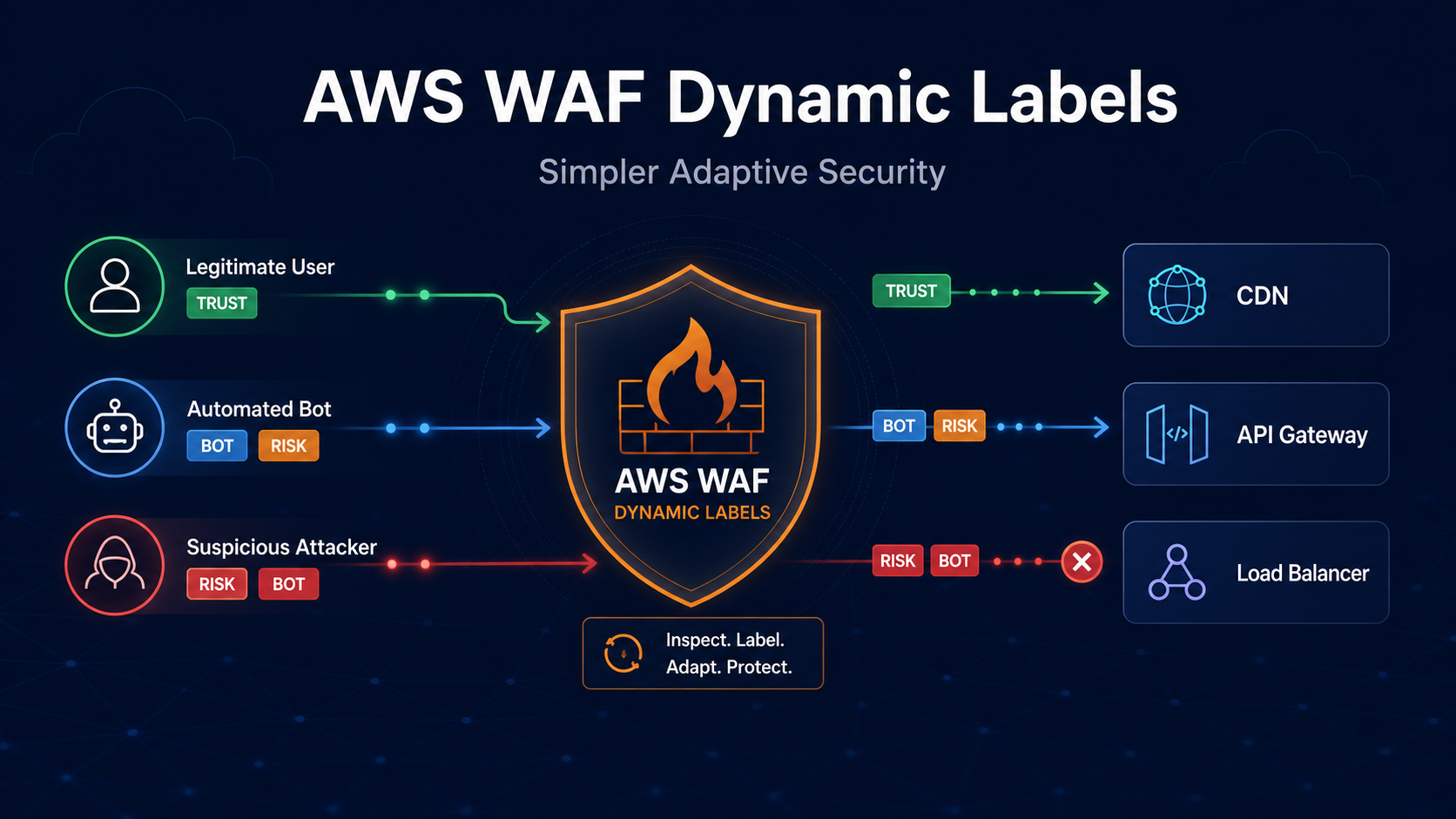
A web application firewall can detect that a request came from a suspicious network, resembles an automated bot or carries an unusual TLS fingerprint. The application behind the firewall often needs that context to decide what happens next. Until recently, passing many AWS WAF label values to an origin could require a separate static mapping for each signal.
AWS WAF dynamic label interpolation changes that pattern. Security teams can use a namespace expression to insert matching label values into request headers, response headers or custom response bodies. Applications can then make risk-aware decisions without the WAF configuration listing every possible label individually.
Key takeaways
- AWS WAF supports dynamic label interpolation using a
${namespace:}expression. - Resolved labels can be passed to an origin through custom request headers.
- Labels and synthetic request values can also appear in custom responses.
- Potential uses include adaptive authentication, cache segmentation and better false-positive troubleshooting.
- Forwarded security headers must be trusted only when they come through the protected path.
What an AWS WAF label represents
Rules can attach labels to requests when they identify a condition. A managed bot rule might classify automation, while an IP reputation rule can signal suspicious infrastructure. Custom rules can add an organisation’s own classifications.
Labels are useful inside WAF rule evaluation, but applications sometimes need the same information. For example, a login service may allow a low-risk request to proceed normally while requiring additional authentication when several risk indicators are present.
How dynamic interpolation works
AWS says the new syntax resolves matching values at request-evaluation time. Instead of creating a separate rule-to-header mapping for every label, a team can reference an entire namespace. When more than one label matches, the values resolve into a comma-separated list.
Interpolation can be used in three places:
- Custom request headers: forward classifications to the protected origin.
- Custom response headers: include dynamic context in a response, including redirects where appropriate.
- Custom response bodies: add a request reference to a block or challenge page.
AWS also provides synthetic labels derived from request context, including the client IP address, WAF request ID and JA3 or JA4 TLS fingerprints.
Example: step-up authentication for risky traffic
Suppose an authentication service receives requests through AWS WAF. Managed rules classify bot activity and IP reputation. The WAF forwards matched classifications in a controlled header. The application combines that signal with its own context, such as account history and device recognition.
A normal request continues to the password or passkey flow. A request carrying stronger risk signals can require multifactor authentication, impose a rate limit or enter a fraud-review queue. The WAF provides evidence; the application makes the business decision.
This is safer than treating every automated request as malicious. Search crawlers, accessibility tools and corporate automation can resemble bots, so policy should consider multiple signals and provide a recovery path for legitimate users.
Example: more useful block pages
A generic “access denied” page gives a user and support team little information. By including an AWS WAF request ID in a custom response, support staff can correlate a complaint with logs without exposing internal rule details. This can shorten investigation of false positives.
Do not include sensitive internal labels or security logic in public response bodies. A reference identifier is useful; a detailed explanation of every detection may help an attacker tune around the control.
Security precautions
Prevent clients from spoofing classification headers
An attacker can send a header with the same name unless the architecture removes or overwrites untrusted inbound values. Origins should accept the classification only through the expected CloudFront, load balancer or API path, and direct public access should be restricted.
Treat labels as signals, not proof
A bot label or fingerprint is one input. High-impact actions such as locking an account should use additional evidence and carefully tested thresholds.
Control logging and privacy
Client IP addresses and TLS fingerprints can become sensitive operational data. Teams should define retention, access and masking rules appropriate to their legal and privacy obligations.
Test cache behaviour
When WAF is in front of CloudFront, inserted headers can affect the cache key if configured that way. This enables content segmentation but can also reduce cache efficiency or create incorrect variants when designed poorly.
Why this matters in the US and India
US organisations can use the feature to join edge security signals with application-level fraud controls, particularly for login, checkout and account-recovery workflows. Privacy and sector-specific compliance remain important when request data is logged.
Indian consumer platforms frequently handle sudden traffic spikes around sales, ticket releases and payment events. Dynamic classification can help distinguish legitimate demand from harmful automation, but aggressive challenges may block users on shared mobile networks. Regional testing and a low-friction recovery path are essential.
A safe adoption checklist
- Inventory existing static label-to-header mappings.
- Select a narrowly defined adaptive decision to test.
- Overwrite spoofable inbound headers at the edge.
- Restrict direct access to the origin.
- Validate multiple-label and empty-label behaviour.
- Keep sensitive rule information out of public responses.
- Monitor false positives and authentication abandonment.
- Document a rollback to the previous static configuration.
Final thoughts
Dynamic label interpolation reduces configuration repetition and makes AWS WAF classifications more useful beyond the firewall. Its best use is not to hand every security decision to one label. It is to deliver trustworthy context to an application that combines edge signals with identity, transaction and business information.
Teams that secure the header path, minimise exposed data and measure false positives can build more adaptive controls without maintaining an expanding collection of static mappings.